Understanding MCP Lifecycle In Detail
When most developers first hear about the Model Context Protocol, they usually think of it as a mechanism for connecting AI models with external tools such as GitHub, Google Drive, databases, or APIs. While that understanding is partially correct, it only scratches the surface of what MCP is actually trying to achieve. MCP is not merely a tool integration layer; it is a structured communication protocol that defines how AI systems and external services establish connections, negotiate capabilities, exchange requests, maintain operational state, and terminate communication safely without creating inconsistencies between systems.
This distinction is extremely important because modern AI systems are no longer isolated chat interfaces that simply generate text in response to prompts. Today’s AI applications increasingly behave like operational systems that continuously interact with filesystems, cloud platforms, developer tools, enterprise applications, productivity suites, and autonomous workflows. Once AI begins interacting with real-world systems, communication reliability becomes just as important as model intelligence itself, because even a highly capable model becomes unreliable if the surrounding protocol architecture is poorly designed.
This is exactly where the MCP lifecycle becomes important.
The lifecycle defines the complete journey of communication between an MCP client and an MCP server, beginning from the very first initialization request and continuing all the way until the connection is terminated. The official MCP specification treats lifecycle management as a foundational aspect of the protocol because proper initialization, capability negotiation, and operational state management are essential for maintaining safe and predictable interactions between AI systems and external tools.
Why MCP Needs a Lifecycle
Before discussing the actual lifecycle phases, it is important to first understand why MCP even needs a lifecycle in the first place, because without understanding the underlying problem the protocol design decisions may feel unnecessarily formal or complicated.
Imagine a scenario where an AI assistant wants to interact with multiple external systems such as GitHub repositories, email services, research databases, or local filesystems. In a traditional architecture, developers usually create direct integrations for every individual service. One integration handles GitHub authentication, another handles Google Drive APIs, another handles database communication, and so on. Each integration often behaves differently, exposes different capabilities, follows different authentication flows, and requires separate orchestration logic.
As the number of integrations grows, the system becomes increasingly fragmented and difficult to maintain.
MCP attempts to solve this problem by introducing a standardized protocol layer between AI applications and external systems. However, standardization only works when all participating systems follow predictable communication rules. If a client starts sending requests before the server is ready, or if the server exposes unsupported capabilities without proper negotiation, the entire interaction quickly becomes unstable.
For example, imagine a client attempting to invoke a tool that the server does not support, or a server expecting a protocol version different from the one the client understands. Without structured lifecycle management, these kinds of incompatibilities would create unreliable and unpredictable behavior throughout the session.
The lifecycle exists precisely to prevent these problems.
Instead of allowing arbitrary communication, MCP defines a disciplined sequence that both the client and server must follow so that compatibility, capabilities, and operational expectations are established before real work begins.
The specification explicitly describes the lifecycle as a process intended to ensure proper capability negotiation and state management between clients and servers.
The Three Major Phases of the MCP Lifecycle
At a high level, the MCP lifecycle is divided into three major phases:
- Initialization
- Operation
- Shutdown
Although these three stages may appear simple on paper, they collectively establish the operational foundation of the entire protocol.
A useful way to visualize the lifecycle is to think of it as a structured state transition system:
Disconnected
      ↓
Initialization
      ↓
Capability Negotiation
      ↓
Operational Communication
      ↓
Graceful Shutdown
      ↓
Disconnected
Every MCP session moves through these phases in a predictable sequence, and understanding this sequence is one of the most important aspects of understanding MCP itself.
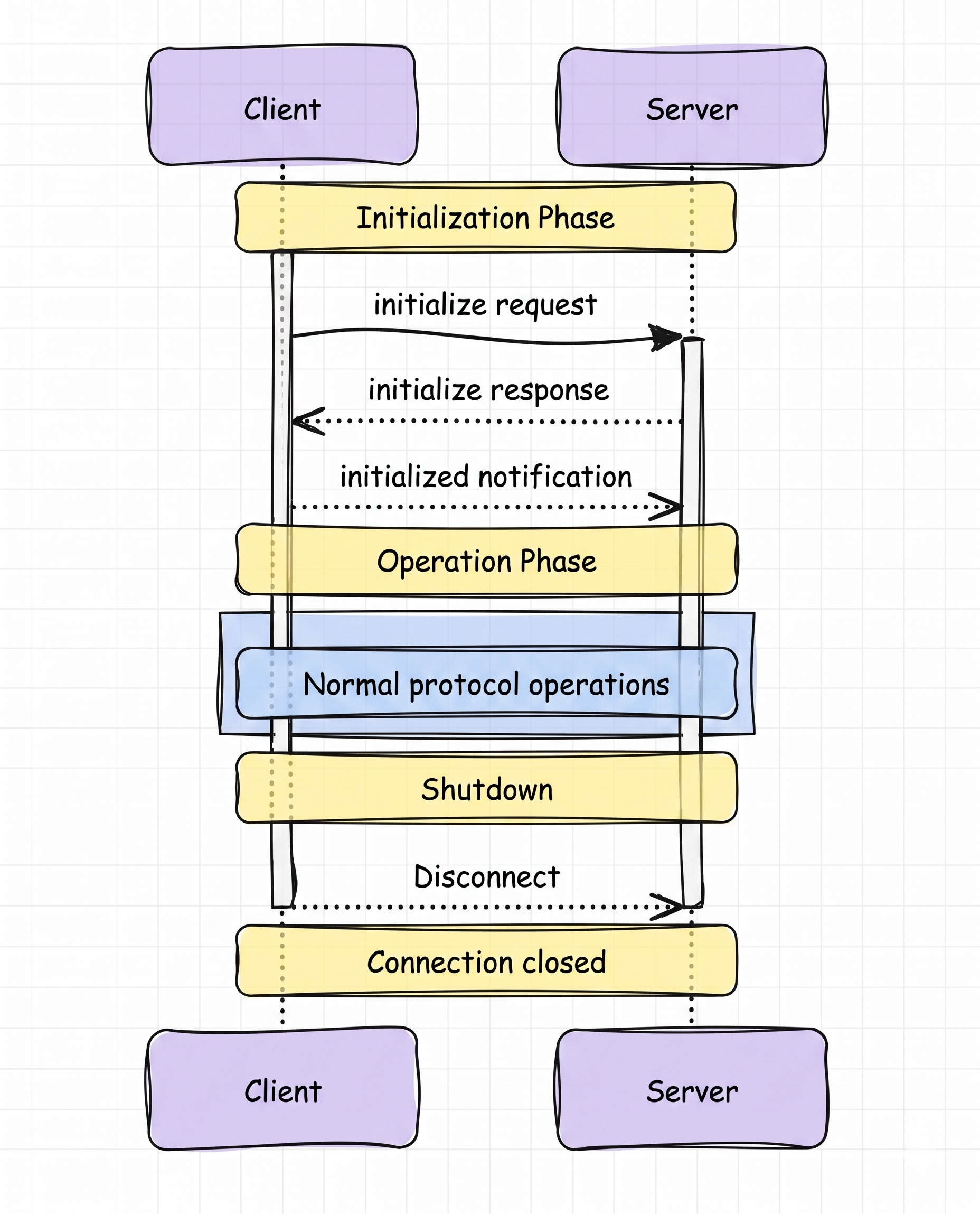
Understanding the Roles of Client and Server
Before we study the initialization process in detail, we first need to clearly understand the architectural roles inside MCP because many beginners accidentally mix up hosts, clients, and servers.
In MCP terminology, the host is usually the main AI application that the user interacts with directly. Applications such as Claude Desktop can act as hosts because they provide the user-facing environment where conversations and workflows occur.
Inside the host lives the MCP client, which is responsible for managing communication with MCP servers. The client handles protocol messaging, lifecycle management, request execution, and capability negotiation.
The MCP server, on the other hand, exposes capabilities such as tools, prompts, resources, or other operational functionality. A GitHub MCP server may expose repository-related operations, while a filesystem MCP server may expose file access functionality.
One important detail that developers often overlook is that each client-server connection behaves like an independent communication session with its own lifecycle and negotiated state. This architectural separation is extremely valuable because it allows AI systems to remain modular and extensible instead of becoming tightly coupled monoliths.
Phase One — Initialization
The initialization phase represents the foundation of the entire MCP lifecycle because this is the stage where both the client and server establish a shared understanding of how communication will proceed before any actual operational requests are allowed to occur.
According to the official specification, initialization MUST be the very first interaction between the client and server, which means that normal operations cannot begin until initialization completes successfully.
This requirement exists because both sides need to agree on several critical details before meaningful communication becomes possible.
During initialization, the protocol establishes:
- Protocol version compatibility
- Capability negotiation
- Implementation metadata exchange
- Session readiness
You can think of initialization as a formal handshake where both sides introduce themselves and define the operational boundaries of the session.
The Initialize Request
The initialization sequence begins when the client sends an initialize request to the server. This request contains important metadata that allows the server to understand what kind of client it is communicating with and what features the client supports.
A simplified version of the request looks like this:
{
  "jsonrpc": "2.0",
  "id": 1,
  "method": "initialize",
  "params": {
    "protocolVersion": "2025-03-26",
    "capabilities": {
      "roots": {
        "listChanged": true
      },
      "sampling": {}
    },
    "clientInfo": {
      "name": "ExampleClient",
      "version": "1.0.0"
    }
  }
}
Although this request initially appears to be ordinary JSON-RPC data, every field inside it serves an important purpose in establishing the session correctly.
Protocol Version Negotiation
One of the first responsibilities of initialization is protocol version negotiation because MCP evolves over time and different implementations may support different protocol revisions.
This may initially seem like a small detail, but in distributed systems version mismatches are one of the most common causes of communication failures. A newer client may support features that an older server does not recognize, while an older client may fail to understand newer protocol semantics introduced by recent versions.
To avoid these problems, the client explicitly declares the protocol version it supports during initialization:
"protocolVersion": "2025-03-26"
The server then determines whether it can safely operate using that version.
If compatibility cannot be established, the connection should terminate instead of continuing with undefined or unreliable behavior. This strictness may feel excessive initially, but it is one of the reasons MCP communication remains predictable and maintainable as the ecosystem grows.
Capability Negotiation
After protocol compatibility comes one of the most important concepts in the entire MCP architecture: capability negotiation.
Capability negotiation exists because neither the client nor the server should assume that the other side supports every possible feature defined by the protocol. Different servers expose different operational abilities, and different clients may implement different optional protocol features.
Without capability negotiation, the client could easily attempt unsupported operations, leading to inconsistent behavior or failures during execution.
During initialization, the client advertises its supported capabilities. For example:
"capabilities": {
  "roots": {
    "listChanged": true
  },
  "sampling": {}
}
This information allows the server to adapt its behavior according to the features available on the client side.
The server then responds with its own capabilities, allowing the client to understand what operations are available during the session.
This process creates a mutually understood operational contract between both sides.
Understanding the Roots Capability
One capability shown in the initialization example is roots, which represents locations or scopes the client is willing to expose to the server.
These roots may represent:
- Workspace directories
- Project folders
- Sandboxed file boundaries
- Accessible resource locations
The optional listChanged property indicates whether the client can notify the server dynamically when available roots change during the session.
This capability becomes extremely useful in AI-assisted development environments where project structures may evolve while the AI is actively interacting with the workspace.
Understanding the Sampling Capability
Another extremely important capability is sampling.
Sampling allows the server to request language-model-generated content from the client instead of hosting the model internally. This design decision is actually very elegant because it keeps model execution centralized within the host application while still allowing external MCP servers to leverage AI reasoning capabilities when needed.
In other words, the server does not necessarily need to own or manage the LLM itself. Instead, it can delegate generation tasks back to the client.
This separation keeps the architecture modular and avoids unnecessary duplication of model infrastructure.
Client Metadata and Implementation Information
The initialization request also includes implementation metadata:
"clientInfo": {
  "name": "ExampleClient",
  "version": "1.0.0"
}
At first glance this information may appear unimportant, but in real ecosystems implementation metadata becomes extremely valuable for debugging, telemetry, compatibility analysis, and vendor-specific optimizations.
When many different MCP clients and servers interact across large environments, knowing which implementation versions are involved can significantly simplify troubleshooting and operational analysis.
The Server’s Initialization Response
Once the server receives the initialize request and validates compatibility, it responds with its own initialization result containing protocol agreement details and server capabilities.
A simplified response looks like this:
{
  "jsonrpc": "2.0",
  "id": "4711",
  "result": {
    "protocolVersion": "2025-03-26",
    "capabilities": {
      "prompts": {
        "listChanged": true
      },
      "tools": {}
    },
    "serverInfo": {
      "name": "MyServer",
      "version": "0.8.15"
    }
  }
}
At this stage, both sides now understand:
- Which protocol version is active
- Which features are available
- Which capabilities are supported
- Which implementations are participating
However, the initialization sequence is still not fully complete.
The Importance of notifications/initialized
One of the most commonly misunderstood parts of the MCP lifecycle is the final initialization notification sent by the client after processing the server response successfully.
The client sends:
{
  "jsonrpc": "2.0",
  "method": "notifications/initialized"
}
This message acts as the final confirmation that the client has successfully processed the negotiated session state and is now ready to begin normal operations.
An extremely important detail here is that this is a notification, not a request, which means no response is expected from the server.
This message essentially communicates:
“Initialization is complete, and the client is now ready for operational communication.”
Only after this step does the lifecycle transition into the operational phase.
Why This Final Notification Matters
This final notification exists to eliminate ambiguity between the client and server regarding session readiness.
Without this confirmation, the server would not know whether:
- The client successfully processed capabilities
- The negotiated protocol version was accepted
- The client completed internal initialization
- Operational communication can safely begin
The notifications/initialized step therefore creates a clean and deterministic transition between initialization and operation, which is one of the reasons MCP sessions remain reliable and predictable.
Phase Two — Operational Communication
Once initialization completes successfully, the MCP lifecycle enters its most active and practically important stage: operational communication.
This is the phase where the actual value of MCP becomes visible because this is where AI systems begin interacting with tools, resources, prompts, and external services exposed by MCP servers.
The operational phase includes activities such as:
- Discovering tools
- Invoking operations
- Fetching resources
- Retrieving prompts
- Receiving notifications
- Managing progress updates
- Handling long-running workflows
Unlike initialization, which is highly structured and strict, the operational phase is intentionally flexible because different AI applications may require dramatically different interaction patterns.
Tool Discovery
One of the first things that typically happens during operational communication is tool discovery.
The client usually sends a request such as:
tools/list
The server then responds with definitions for the tools it exposes, including metadata such as:
- Tool names
- Descriptions
- Input schemas
- Operational expectations
This dynamic discovery model is extremely powerful because it allows AI systems to understand available functionality at runtime instead of relying on hardcoded integrations.
Rather than embedding static assumptions directly into the AI application, MCP allows capabilities to become discoverable and self-describing.
This creates a much more extensible ecosystem.
Tool Invocation
After discovering available tools, the client can invoke them using requests such as:
tools/call
The operational flow generally follows a sequence like this:
Discover Tools
      ↓
Understand Schemas
      ↓
Select Appropriate Tool
      ↓
Execute Operation
      ↓
Receive Result
This structured interaction model is one of the reasons MCP-based AI systems feel significantly more disciplined than loosely connected automation systems.
Resources and Prompts
MCP does not only support tools. The same architectural philosophy extends to resources and prompts as well.
For resources, operations commonly include:
resources/list
resources/read
For prompts:
prompts/list
prompts/get
One of the elegant aspects of MCP design is that these interaction patterns remain highly consistent across different protocol primitives, making the ecosystem easier to learn and reason about.
Notifications During Operation
Operational communication also includes notifications, which allow asynchronous updates without requiring direct request-response flows.
These notifications may include:
- Resource changes
- Progress updates
- List modifications
- State synchronization events Unlike requests, notifications do not expect responses, which allows the protocol to support non-blocking communication patterns efficiently.
This becomes especially important in long-running workflows where continuous state updates may occur during execution.
Error Handling and Timeouts
Real-world systems are never perfectly reliable, which means MCP must also handle failures gracefully. Servers may become unavailable. Requests may timeout. Networks may behave unpredictably. Long-running operations may fail midway through execution.
The MCP lifecycle therefore includes structured handling for:
- Errors
- Cancellation
- Progress reporting
- Timeouts
These concerns are integrated directly into the communication model instead of being left undefined, which significantly improves operational reliability in complex AI workflows.
Stateful Nature of MCP Sessions
One of the most important ideas developers must understand is that MCP communication is stateful.
The lifecycle is not simply a collection of isolated requests. Instead, the session maintains negotiated assumptions and operational context throughout its lifetime.
For example:
- Negotiated protocol versions remain active
- Capabilities remain valid
- Session assumptions persist
- Operational context remains consistent
This persistent state is precisely why initialization is treated so seriously by the specification.
Phase Three — Shutdown
Eventually, every MCP session reaches its final stage: shutdown. Interestingly, the MCP protocol intentionally keeps shutdown relatively lightweight compared to initialization. In most cases, shutdown simply occurs when the transport connection closes.
For stdio transport:
- Streams are closed
- Processes terminate
For HTTP or SSE transport:
- The connection itself terminates
Although the protocol does not define a highly elaborate shutdown handshake, graceful termination still remains extremely important in practice.
Importance of Graceful Shutdown
Even though shutdown may appear simple conceptually, improper termination can still create serious operational issues. For example, abrupt termination during active operations could leave:
- File writes incomplete
- Responses partially transmitted
- Temporary state corrupted
- Background operations hanging
A good MCP implementation therefore attempts to finish active requests, flush pending communication, release resources safely, and terminate connections cleanly before ending the session entirely. This becomes increasingly important as AI systems begin handling larger and more autonomous workflows.
Transport-Specific Shutdown Behavior
Shutdown behavior also depends partly on the transport mechanism being used.
With stdio transport, the client often launches the server as a subprocess and communicates through standard input/output streams. Shutdown typically involves closing these streams and waiting for process termination.
With HTTP or Server-Sent Events transport, shutdown is usually simpler because the underlying transport already defines connection lifecycle semantics.
Understanding these transport differences is important because operational behavior can vary depending on the communication mechanism used by the MCP implementation.
Why the MCP Lifecycle Design Works So Well
One of the most elegant aspects of MCP is that the lifecycle remains surprisingly minimal while still being highly structured. Initialization is strict because compatibility and capability negotiation must be reliable.
Operational communication is flexible because AI workflows vary enormously across applications.
Shutdown is intentionally lightweight because overly complicated teardown procedures often introduce unnecessary fragility into distributed systems. This balance between structure and simplicity is one of the reasons MCP feels practical rather than overly academic.