LangChain Components
Introduction
This tutorial will act as a foundation as well as a roadmap, helping you understand not just what LangChain does, but how it is internally organized and how you should think about it as a framework.
Why LangChain Exists
When working with different AI providers such as OpenAI, Anthropic, or Google, one quickly realizes that each provider exposes its own API format, response structure, and integration pattern. This means that if you build an application using one provider and later decide to switch to another, you often need to rewrite a significant portion of your code, which is both time-consuming and error-prone.
LangChain solves this problem by introducing a standardized interface, allowing developers to interact with different models in a consistent way, so that switching providers becomes a matter of small adjustments rather than a full rewrite.
The 6 Core Components of LangChain
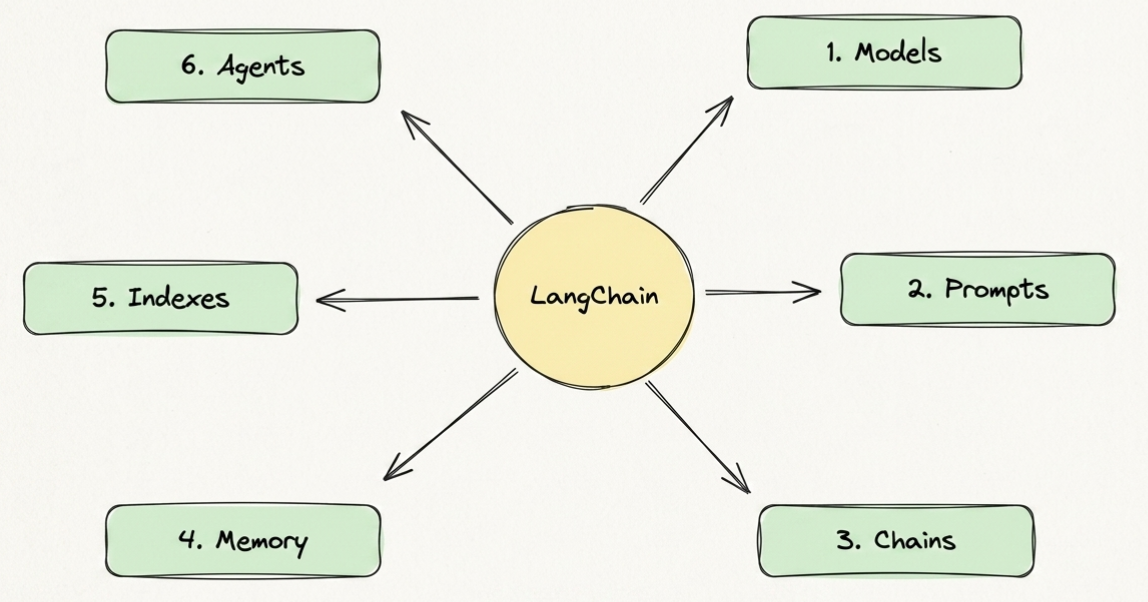
LangChain is built around six fundamental components, and understanding these components gives you a strong mental model of how the framework works as a whole.
These components are:
- Models
- Prompts
- Chains
- Memory
- Indexes
- Agents
Instead of thinking of them as isolated features, it is better to think of them as layers of responsibility, where each component handles a specific aspect of an AI application.
1. Models – The Core Interface to AI
The Models component is the most fundamental part of LangChain, because it is the layer through which your application communicates with AI systems.
Why Models Are Needed
Before LangChain, interacting with different AI providers required writing provider-specific logic, since each API behaved differently and returned responses in its own format. This lack of standardization made applications harder to maintain and even harder to extend.
LangChain addresses this by providing a common interface, which allows you to communicate with multiple AI providers using almost the same code structure, thereby reducing complexity and improving flexibility.
Types of Models
LangChain primarily works with two types of models, and understanding the difference between them is crucial.
Language Models
Language models follow a simple yet powerful pattern where they take text as input and return text as output, making them ideal for tasks such as chatbots, summarization, content generation, and question answering.
Embedding Models
Embedding models, on the other hand, do not return text but instead convert input text into numerical vectors, which represent the semantic meaning of the text and are widely used for similarity search, recommendation systems, and RAG-based applications.
2. Prompts – The Input That Drives Everything
A prompt is the input you send to a language model, but in practice, it plays a much more important role than it might initially appear.
Why Prompts Are Critical
The output of an LLM is highly sensitive to the prompt, which means that even small changes in wording can lead to significantly different responses. Because of this sensitivity, designing effective prompts has become an important skill, often referred to as prompt engineering.
Types of Prompts in LangChain
LangChain provides structured ways to create and manage prompts, making them more powerful and reusable.
Dynamic Prompts
Instead of writing fixed inputs, you can create templates with placeholders, allowing the same prompt to adapt to different inputs at runtime.
Example:
Summarize {topic} in {tone}
Role-Based Prompts
You can guide the model’s behavior by assigning it a role, such as asking it to behave like a doctor, teacher, or engineer, which significantly influences the style and depth of the response.
Few-Shot Prompts
You can provide examples before asking a question, allowing the model to learn the expected pattern and produce more accurate outputs based on those examples.
3. Chains – Building Logical Pipelines
Chains are one of the most powerful features of LangChain, because they allow you to combine multiple steps into a single structured workflow.
Why Chains Are Needed
In real-world applications, a single model call is often not sufficient, and you need to perform multiple operations in sequence, such as translating text and then summarizing it. Without chains, you would need to manually manage the flow of data between these steps.
Chains simplify this by automatically passing the output of one step as the input to the next, thereby reducing boilerplate code and making the workflow easier to maintain.
Types of Chains
Sequential Chains
These execute steps one after another in a fixed order.
Parallel Chains
These allow multiple processes to run simultaneously and combine their outputs later.
Conditional Chains
These change the flow of execution based on specific conditions, making the pipeline more dynamic and intelligent.
4. Indexes – Connecting External Knowledge
While LLMs are powerful, they are limited to the data they were trained on, which means they cannot answer questions about private or domain-specific data.
Why Indexes Are Important
Indexes allow you to connect your application to external data sources such as PDFs, databases, or websites, enabling your system to answer questions based on your own data rather than relying only on pre-trained knowledge.
Components of Indexing
Indexes are composed of multiple sub-components working together:
- Document Loader → Loads data
- Text Splitter → Breaks data into chunks
- Vector Store → Stores embeddings
- Retriever → Fetches relevant data
With indexes, you can build systems where users can query private data, such as company documents, and receive accurate, context-aware responses.
5. Memory – Making Conversations Contextual
By default, LLM APIs are stateless, meaning they do not remember previous interactions, which can lead to confusing or incomplete conversations.
The Problem
If a user asks a follow-up question, the model may not understand the context, since it has no memory of earlier queries.
The Solution
LangChain introduces memory mechanisms that allow you to retain context across interactions, making conversations more natural and coherent.
Types of Memory
- Buffer Memory → Stores full conversation
- Window Memory → Stores recent interactions
- Summary Memory → Stores summarized context
- Custom Memory → Stores specific important data
6. Agents – From Responses to Actions
Agents represent the most advanced capability in LangChain, as they go beyond simply generating responses and can actually perform actions.
A chatbot can understand and respond, but an agent can also think, decide, and act.
How Agents Work
Agents combine:
- Reasoning ability
- Access to tools
This allows them to break down problems into steps and use external tools such as APIs or calculators to complete tasks.